
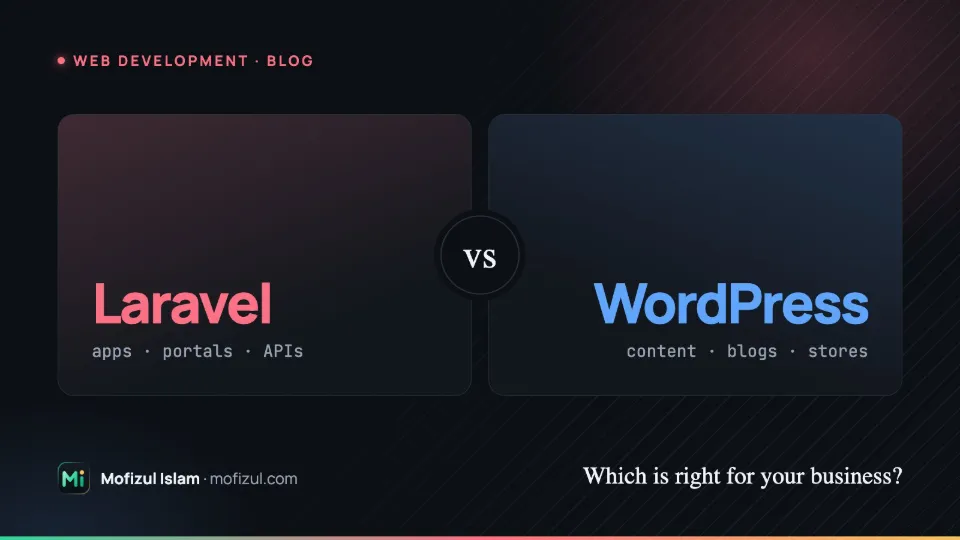
Choosing a platform is one of the first decisions in any web project. It is also one of the most expensive to undo. Clients often ask me about Laravel vs WordPress, because I build with both. However, the honest answer is that each one wins in different situations.
In this guide I compare them on the points that matter to a business: cost, speed, security, editing and growth. At the end, you will find a simple way to decide.
Laravel vs WordPress in one sentence
WordPress is a content management system. Laravel is a PHP framework for building custom applications. In other words, WordPress gives you a ready-made website you can shape, while Laravel gives you building blocks for software that does not exist yet.
Both run on PHP and MySQL, so they can share the same hosting. Still, they solve different problems.
When WordPress is the better choice
WordPress powers a huge share of the web, and for good reason. It shines when content is the main product.
- Company websites and blogs. As a result, your team can edit pages and publish posts without a developer.
- Online stores. WooCommerce covers products, carts, payments and shipping out of the box.
- Fast launches. A solid theme and a few plugins can take you live in days, not months.
- Tight budgets. Thousands of free plugins cover common features, so you pay less for custom code.
Also, WordPress has a huge talent pool. If your developer disappears, finding another one is easy.
When Laravel is the better choice
Laravel is the better fit when your website is really an application. For example, think of customer portals, booking systems, SaaS products or internal tools.
- Custom business logic. Complex rules, roles and workflows are easier to model in clean code.
- APIs for mobile apps. Laravel is excellent as a backend for React or Flutter apps.
- Heavy data. Large databases, reports and background jobs run more predictably.
- Long-term products. Tests, migrations and queues keep a growing codebase under control.
In short, Laravel gives you full control. The trade-off is that everything must be built, including the admin screens.
Cost: Laravel or WordPress?
In most cases, WordPress is cheaper to start. A business website or small store needs mostly setup, design and a little custom code. As a result, the first version costs less and ships sooner.
Laravel costs more up front because features are written from scratch. However, for complex products it can cost less over time. You avoid fighting plugins that were never designed for your use case.
So compare the total cost over two or three years, not just the launch price.
Performance and security
Both can be very fast and very secure. The difference is where the risk comes from.
With WordPress, most problems come from slow or poorly coded plugins. Therefore, keep the plugin list short, update often and use caching. I cover this in my WooCommerce speed guide and my WordPress security checklist.
With Laravel, quality depends on the code your team writes. Also, the framework includes protection against SQL injection, cross-site scripting and CSRF by default. Still, a careless developer can switch those protections off.
Content editing and day-to-day use
This is where WordPress clearly wins. The block editor, media library and user roles are familiar to millions of people. Your marketing team can work without asking for help.
In contrast, Laravel has no editor by default. You can add an admin panel, but every screen is extra work. If your team publishes content daily, that matters a lot.
Hosting and maintenance
A WordPress site runs on almost any PHP host, including cheap shared plans. However, it needs regular updates for core, themes and plugins. If nobody updates it, it slowly becomes slow and unsafe.
A Laravel app usually needs a VPS or a managed platform, plus a deploy process. On the other hand, it changes only when your team changes it, so there are fewer surprise updates. Because of that, maintenance is more predictable, but each change needs a developer.
In both cases, budget a few hours per month for updates, backups and monitoring. That small cost prevents the large bill of a hacked or broken site.
Can you combine Laravel and WordPress?
Yes, and it is often the best answer. A common pattern is WordPress for the marketing site and blog, plus a Laravel app for the product itself. For instance, the public pages live on example.com and the customer portal lives on app.example.com.
Another option is headless WordPress. Here, editors keep the WordPress admin, while a custom front end fetches the content through the REST API.
A simple way to choose between Laravel vs WordPress
Ask yourself three questions:
- Is content the main product? If yes, start with WordPress.
- Do users log in to do real work? If yes, Laravel is likely the better core.
- Will you sell products online? If the store is standard, WooCommerce is hard to beat.
If you answered yes to both of the first two, consider the combined approach above.
Final verdict
There is no winner in the Laravel vs WordPress debate, only a better fit. Pick WordPress for content and standard stores. Pick Laravel for custom applications and APIs. Finally, pick a developer who knows both, so the choice is made for your business and not for their comfort.
Not sure which one fits your project? Tell me what you are building and I will give you an honest recommendation. You can also see the services I offer.